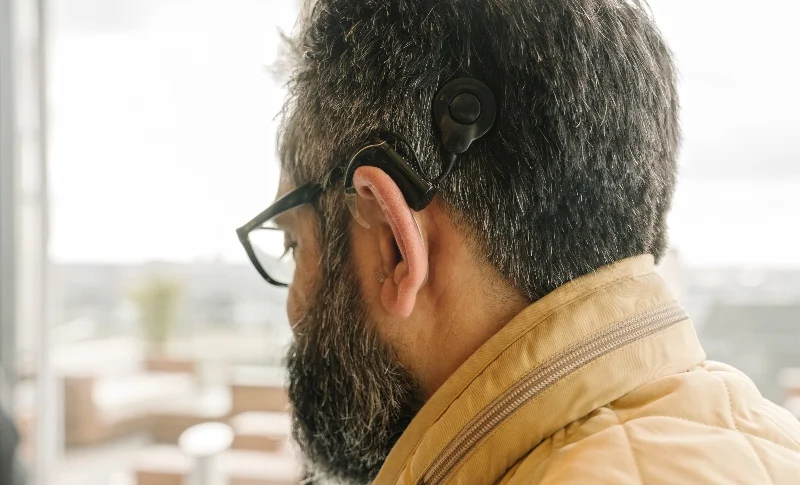
While hearing aid technology is extremely impressive today, hearing aids cannot cure all forms of hearing loss. Where hearing aids fail to meet the needs of certain patients, implantable solutions can provide significant improvement.
Cochlear implants and osseointegrated implants are remarkable devices that have transformed the way we approach hearing loss. While many people think of a cochlear implant as a single type of technology, there are actually several different kinds, each designed to meet specific hearing needs, lifestyles, and medical considerations.
In this article, I will explore the various types of implantable devices, how they work, and what makes each one unique in restoring the gift of sound.
Cochlear Implants
for Severe to Profound Hearing Loss
For patients with severe to profound hearing loss, or those with less than 60% speech discrimination in the better hearing condition, cochlear implant technology is recommended.
Most people struggle to understand speech with hearing aids because they have lost too many sensory cells in the cochlea. Sensory cells receive the sound we hear and turn that sound into electrical impulses at their synapse with the auditory nerve. Therefore, when there are no sensory cells to simulate, there is no way for the auditory nerve to receive stimulation.
How a Cochlear Implant Works
A cochlear implant works by directly stimulating the auditory nerve by inserting an electrode into the cochlea. The system has two main parts: an external processor that picks up sound, converts it into digital signals, and sends them to an internal implant. The internal implant then sends electrical impulses to electrodes placed in the cochlea, which stimulates the auditory nerve. The brain interprets these impulses as sound, allowing the person to hear.
This is a process, not an immediate “cure”. Patients who receive a cochlear implant must go through a rehabilitation process to adjust to hearing differently than they have heard sound in the past. This process can take six to twelve months and can require hearing therapy exercises or classes.
Requirements to Receive A Cochlear Implant
It’s for good reason that not just anyone can receive a cochlear implant. As I mentioned earlier, there are hearing loss requirements and speech comprehension scores that must be met in order to qualify. One of those is 60% or poor speech comprehension in the best hearing condition, which usually means appropriately fit hearing aids in both ears.
The Cochlear Implant Process
The whole purpose of the candidacy testing for a cochlear implant is to make sure that the patient’s performance wearing hearing aids is poor enough to qualify for implantation.
Recently, the FDA also cleared approval for using a cochlear implant for single-sided deafness. The importance here is that the bad ear must have profound sensorineural hearing loss, and the good ear must be completely within normal limits.
Osseointegrated Implants: BAHA & Osia
For Those With Single-Sided Hearing Loss
Next up are what are implants known as “osseointegrated implants”. Included in this category is the BAHA, or Bone Anchored Hearing Aid, and the Osia. These devices are also approved for people who have single-sided hearing loss.
It is important to note that unlike the cochlear implant, to qualify for the BAHA, the hearing loss in the bad ear doesn’t have to be profound; however, the good ear needs to have normal hearing.
These devices are also excellent for people with conductive hearing loss, which is a hearing loss caused in the middle ear. An example of this would be someone who suffers from chronic ear infections. This condition can make wearing a hearing aid very difficult.
How BAHA & Osia Hearing Aids Work
Bone anchored hearing aids and the Osia work in the same way. A titanium implant is placed in the bone behind the ear. Eventually, the bone grows around the implant, hence the term “osseointegrated”. The implant transfers the sound vibration through the bone directly to the cochlea, bypassing the outer and middle ear.
The internal implant has an abutment for the BAHA and a magnet for the Osia, to which the external sound processor attaches. The processor picks up sound, converts it into vibrations, and transfers those vibrations through the bone to the cochlea.
This allows people with conductive or mixed hearing loss—or single-sided deafness—to hear more clearly without relying on the normal sound pathway through the ear canal.
Hearing Aid Implant Process
For those that qualify for this device, it is a straightforward process. The processor can be attached two to four weeks following implantation and typically only requires one fitting appointment. The reason this process is less challenging than a cochlear implant is because the processor is stimulating a normal hearing cochlea.
Hearing Aid Technology Manufacturers
There are so many exciting developments in cochlear and osseointegrated technology.
Osseointegrated Companies
Two manufacturers make osseointegrated options: Cochlear Americas and MED-EL.
Cochlear Implant Companies
There are three companies that manufacture cochlear implants: Cochlear Americas, MED-EL, and Advanced Bionics. Cochlear Americas and Advanced Bionics are owned by a parent company that also owns a hearing aid manufacturer.
This shared ownership between cochlear technology and hearing aid technology can prove beneficial for our patients, as they can use their cell phones, tv streaming technology, and remote microphones with both their hearing aid and cochlear implant (instead of only being able to their devices with one ear).
Next Steps
If you are frustrated with your performance with hearing aids, I recommend you schedule a cochlear implant candidacy evaluation with a clinic that has a cochlear implant program. I always tell patients who are nervous—this is just a test. Once we have the results, it is up to you—the patient—to decide what to do.
But at least after the evaluation, you will know what your options are. I hope you find this information helpful. For more information on these technologies, I recommend visiting the manufacturers’ websites to learn more:
If you would like to discuss this topic further or would like to schedule an appointment to be seen in the local Carroll, Denison, and surrounding communities, you can give us a call at 712-775-2625 or request an appointment.

Dr. Sondra Rierson
About the Author: Dr. Sondra Rierson is an experienced audiologist with more than a decade of expertise in diagnosing and treating hearing loss. Originally from Lake View, Iowa, she is dedicated to providing personalized, patient-centered hearing care.
Subscribe to her YouTube channel for more information and helpful videos.
Join our online community!
Follow on Facebook, LinkedIn, and Instagram, and subscribe to Dr. Rierson’s YouTube channel. She frequently publishes helpful videos and tips online.


